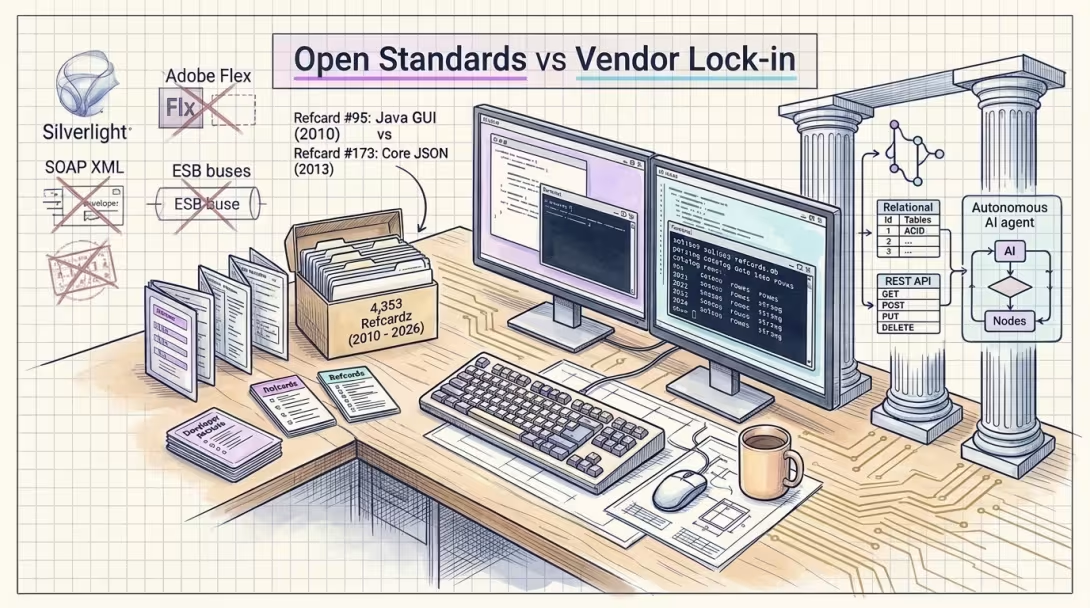
Sorting Through 4,300 DZone Refcards: Which 2010 Bets Paid Off and Which Ones Died
Earlier today, I stumbled across an untouched corner of my inbox: 4,353 DZone Refcardz emails delivered between April 2010 and September 2026.
For engineers who remember the pre-cloud, pre-AI era, DZone Refcardz were the ultimate practical desk reference. They were paid, peer-reviewed, sponsor-backed cheat sheets designed for developers writing production code. When a technology earned a Refcard, it meant enterprise teams were actively wrestling with it.
I extracted the raw delivery logs into a local SQLite database to see where the journey started.
The very first card in my inbox arrived on April 19, 2010: Refcard #95: Getting Started with Java GUI Development. The latest card landed a few weeks ago on September 30, 2026: Let Karpathy Loop agents validate your ML.
Looking at the 126 Refcards published between 2010 and 2012 provides an honest snapshot of what our industry treated as high-priority knowledge. Some of those bets laid the foundation for everything we run today. Others quietly vanished into the tech graveyard.
Here is what happened to 10 technologies that dominated developer attention in 2010, and what they teach us about evaluating modern tools.
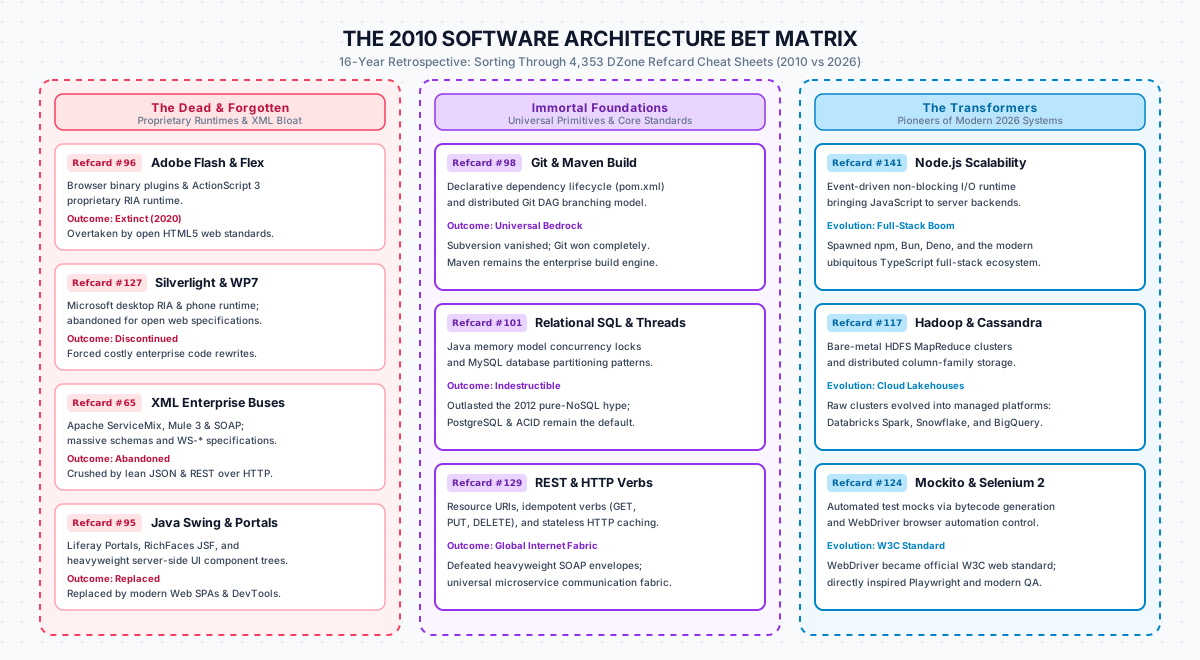
The Dead and Forgotten
1. Adobe Flash, Flex, and Catalyst (Refcard #96, #102, #113, #142, #146)
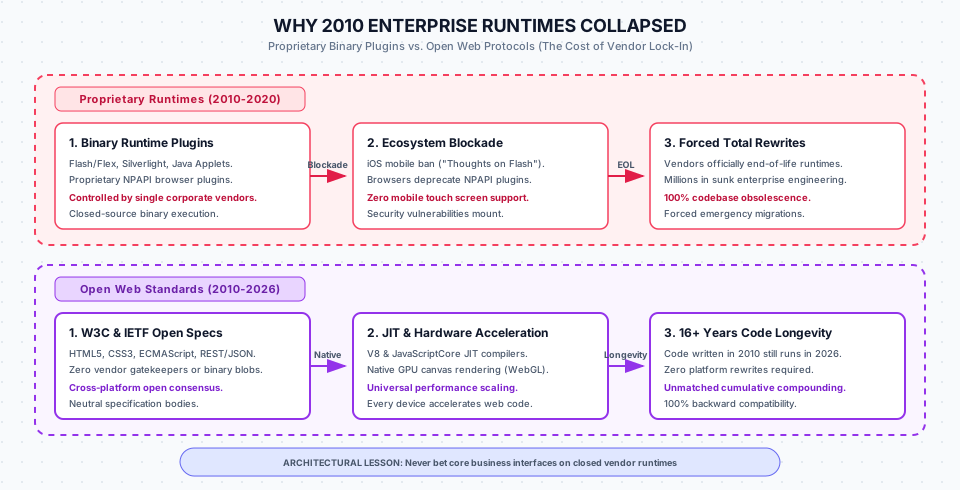
In 2010, the web was struggling to handle rich interactive media. DZone published multiple guides on integrating Adobe Flex with PHP and Spring, prototyping with Flash Catalyst, and writing mobile apps in Flex for Android and BlackBerry.- The Reality: Steve Jobs published Thoughts on Flash in April 2010—the exact same month my archive begins. Within five years, open HTML5 standards caught up, browser plugins were deprecated, and Adobe formally discontinued Flash in 2020. Proprietary browser runtimes lost completely to open web specifications.
2. Silverlight on Windows Phone 7 (Refcard #127)
Microsoft pitched Silverlight as its enterprise-grade answer to Adobe Flash and desktop WPF, with a dedicated push into Windows Phone 7.- The Reality: Windows Phone was discontinued, and Microsoft abandoned Silverlight in favor of web standards and cross-platform native tooling. Any engineering team that rewrote internal business interfaces in Silverlight faced a complete rewrite a few years later.
3. XML Enterprise Service Buses (Refcard #65, #111, #140)
Enterprise software in 2010 revolved around Service-Oriented Architecture (SOA), heavy XML schemas, and Enterprise Service Buses (ESBs) like Apache ServiceMix and Mule 3.- The Reality: The cognitive load of configuring distributed systems via massive XML files collapsed under its own weight. In 2013, DZone published Refcard #173: Core JSON: The Fat-Free Alternative to XML. REST over HTTP/JSON stripped away the complexity of WS-Security and SOAP envelopes, eventually paving the way for lightweight event brokers like Kafka.
4. Heavyweight Java Desktop and Portal UI (Refcard #95, #126, #138)
Refcards on Java Swing, Liferay Enterprise Portals, and RichFaces 4.0 (JSF) assumed that complex business interfaces would either live in desktop window managers or render via server-side component trees inside portlet containers.- The Reality: Single-page applications, browser devtools (which began with FireBug 1.5 in Refcard #108), and JavaScript frameworks completely dismantled portal servers and desktop Java apps for internal enterprise tooling.
The Immortal Foundations
While runtime plugins and bloated XML frameworks died, several 2010 technologies proved indestructible:
5. Git and Maven (Refcard #98, #102, #104)
In 2010, Apache Ant was still popular (Refcard #104), and teams were tentatively experimenting with Git while maintaining Subversion repositories.- The Outcome: Git became the universal version control system of modern software. Maven's declarative lifecycle and central repository established the build standard that still underpins enterprise Java.
6. Relational SQL & Core Concurrency (Refcard #101, #157)
DZone published Refcard #101: Core Java Concurrency and Refcard #157: Database Partitioning with MySQL.- The Outcome: Despite the massive NoSQL hype that followed in 2012, relational databases never lost their throne. Understanding locks, thread safety, ACID guarantees, and database indexing remains just as critical in 2026 as it was in 2010.
7. REST Architecture & HTTP Fundamentals (Refcard #129, #172)
Before microservices had a name, Refcard #129: REST: Foundations of RESTful Architecture walked developers through resource modeling, idempotent methods, and HTTP status codes.- The Outcome: REST became the default communication fabric of the global internet. The protocols and verbs defined decades ago outlasted every framework built on top of them.
The Transformers (The Early Pioneers)
Some 2010 entries didn't stay the same, but directly spawned the modern stack:
8. Node.js (Refcard #141)
In 2011, DZone introduced Node.js: Building for Scalability with Server-Side JavaScript. At the time, running JavaScript outside a browser felt novel and risky.- The Outcome: Node.js democratized full-stack development, introduced npm, and established non-blocking asynchronous I/O across the industry.
9. Apache Hadoop & Cassandra (Refcard #117, #133, #153)
The early Big Data era required deploying raw Hadoop MapReduce clusters and early Cassandra nodes on bare metal.- The Outcome: While raw MapReduce clusters were replaced by managed services like Databricks, Snowflake, and BigQuery, the distributed storage and column-family models from those early Refcards defined modern data engineering.
10. Automated Testing with Mockito and Selenium WebDriver (Refcard #124, #125, #155)
Refcards covered PHPUnit, Selenium 2.0 (the arrival of the WebDriver API), and Mockito for Java.- The Outcome: Mockito remains the default mocking library in Java. Selenium WebDriver became the official W3C standard for browser automation, directly inspiring tools like Playwright and Puppeteer.
What 16 Years of Refcards Teach Us Today
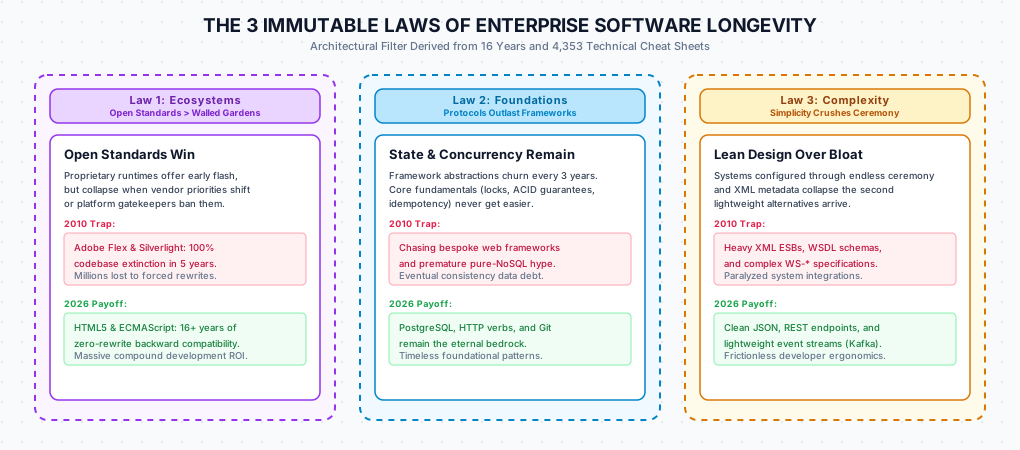
Reviewing these cheat sheets side by side highlights a pattern that repeats every decade:
1. Proprietary ecosystems always lose to open standards. Betting on proprietary vendor runtimes (Flash, Silverlight, proprietary ESBs) created expensive rewrites. Betting on open web protocols (HTTP, HTML5, REST) paid dividends for 15+ years.
2. Abstractions change, but state and concurrency never get easier. Whether you are synchronizing Java threads in 2010 or debugging non-deterministic AI agent execution loops in 2026, the underlying problems are identical: managing mutable state, handling timeouts, and verifying system behavior.
3. Simplicity beats ceremony. The bloated XML configurations of JBoss and ServiceMix were abandoned the moment simpler alternatives (JSON, REST, Spring Boot) appeared.
The technologies dominating our headlines today will face the exact same test of time. Understanding what survived the last 16 years is the best filter we have for building systems that last.