
Biggest eye-opener from Ethan Mollick's 'Co-Existence' talk: why 'Human in the Loop' is obsolete
Yesterday I joined roughly 21,000 people on LinkedIn Live for How to Stay Competitive as AI Changes Work, a 45-minute conversation between Wharton professor Ethan Mollick and LinkedIn Editor-in-Chief Daniel Roth ahead of Mollick's new book, Co-Existence: The Next Phase of AI.
TL;DR
- At 36 minutes, Mollick named "being the human in the loop" as the single piece of advice from his 2024 book Co-Intelligence that aged the worst.
- Multi-step agents now run for hours at a time, turning human step-by-step approval into rubber-stamping and reducing workers to scapegoats when an output fails (24:30).
- Replace line-by-line inspection with loop management: write your own initial framing (19:10), set interim checkpoints, and cross-check critical work across three model families (Gemini 4 Argon, Claude Opus 5.5 / Fable 5.1, and GPT-6.1 Sol at 24:45).
- Individual 100x AI speedups stall out inside enterprises (20:45) unless architects enforce shared boundaries and reuse.
Why "human in the loop" broke
Thirty-six minutes into the broadcast, a viewer named Michael from South Africa asked the sharpest question of the session:
"Looking back at Co-Intelligence, what concept or piece of advice in the book became obsolete faster than you expected?"
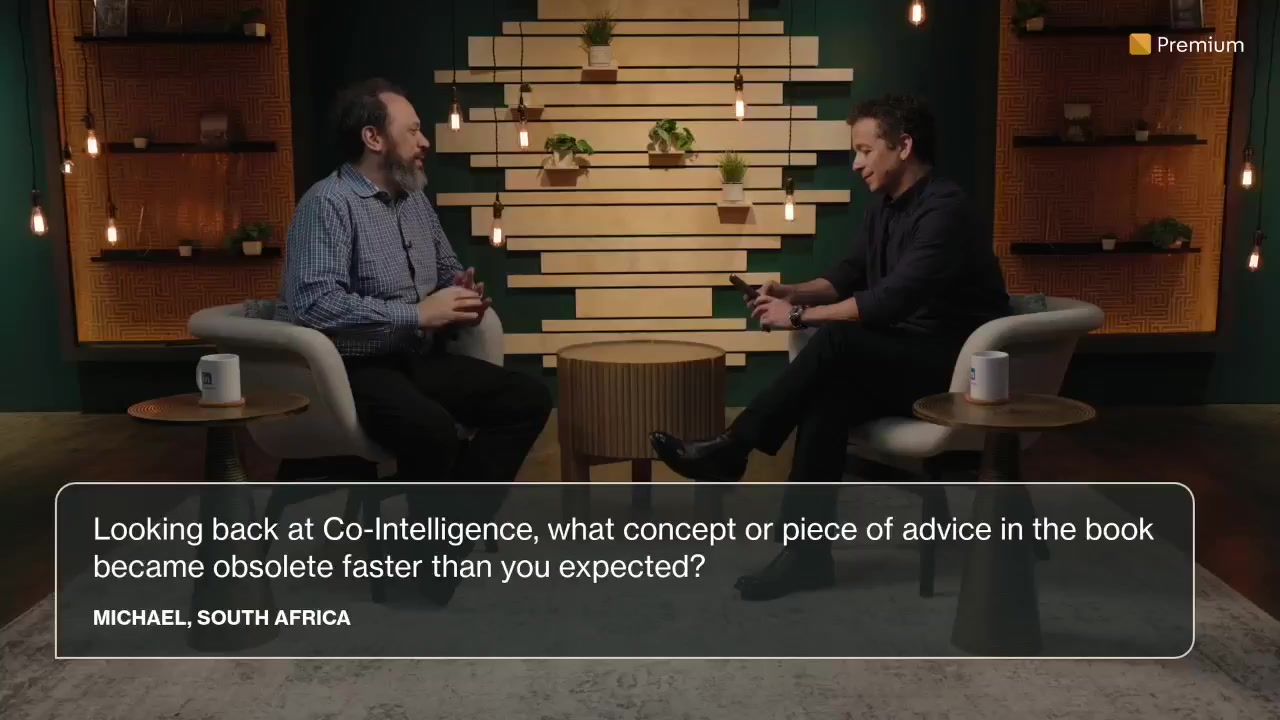 Audience Q&A at 36:48: Ethan Mollick explaining why "being the human in the loop" stopped working once multi-step agents arrived (Watch on LinkedIn Theater at 36:30).
Mollick answered immediately: "The thing that got obsolete fastest was to be the human in the loop. And people hate it when I say that that's obsolete, but it is."
In 2023 and 2024, GPT-4 led every leaderboard (it now sits around #181 globally, as Mollick noted at 24:02). Work happened in five-minute chat turns. If a chatbot wrote one function or a three-paragraph email, you read every line.
Modern agents chain tool calls, edit dozens of files, and make thousands of micro-decisions across hours of autonomous execution. (Mollick cited METR long-horizon curves on the stream claiming 16 hours to several weeks of autonomous work; even setting aside those contested synthetic benchmarks, anyone running coding agents today sees the volume problem firsthand.) Nobody reads 4,000 lines of generated diff with the same focus they bring to a 20-line pull request. As one viewer in the live chat put it: "Approval only means something if I can see what it checked, what it missed, and why it chose that option. Otherwise I'm just clicking yes on a very confident paragraph."
Worse, keeping humans as nominal gatekeepers sets a career trap (24:30):
"I worry that if we don't get past this point, the role of humans will be checking errors for AI. And that's the worst possible job: the AI does all the interesting stuff, and your job is to check the errors and get fired if it's wrong."
Managing the loop instead of sitting inside it
Stepping out of the execution loop requires managing agents the way a technical lead manages a team.
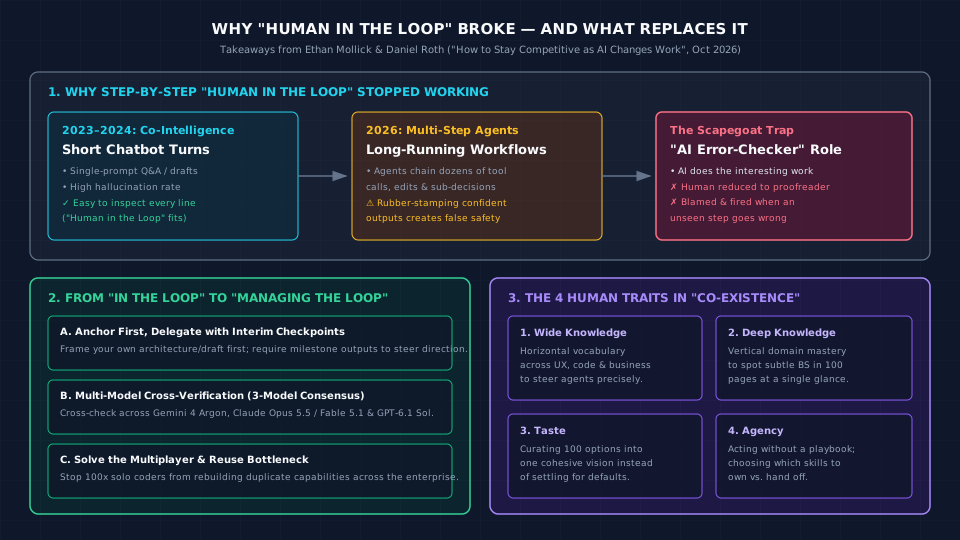
Shifting from 2024's step-by-step inspection to 2026's loop management and the four human traits from Co-Existence.
Three habits stood out from Mollick's workflow:
1. Write your own rough framing before opening the prompt (19:10). LLM prose has strong gravity. If a model writes your first draft, its structure dictates your thinking. Draft your own core argument or architecture notes first, then bring the model in as a hostile reviewer: "If an engineer reads this, where do I sound clueless?" or "Give me the top 3 places where this design is weak."
2. Demand interim checkpoints (15:40). Treat long-running agents like opaque wizards (14:55). Require intermediate deliverables early in the run so you can spot where the model's default judgment diverges from your domain constraints before it burns hours on the wrong approach.
3. Cross-check high-stakes work across three model families (24:45). When Mollick used AI to fact-check his new book manuscript, the model caught statistical errors inside Table 12 of the peer-reviewed papers he was citing (15:15). For critical work, run outputs across Gemini 4 Argon, Claude Opus 5.5 / Fable 5.1, and GPT-6 Astra / 6.1 Sol (41:35). Where all three agree, confidence is high. Where they split, you have the exact edge case that needs human judgment.
The 100x solo trap in enterprise architecture
Throughout the session, Mollick returned to a puzzle he hears constantly from executives (20:45): companies can point to individual employees working at 100x their old speed with AI, yet the organization as a whole ships no faster.
AI tools today optimize for single-player speed. When one developer generates ten times more code or specs, that output piles up in review queues, security gates, and cross-team handoffs.
During the broadcast, I posted a note in the chat from my own seat as a Solution Architect:
When any squad can prompt a new microservice or internal tool into existence in an afternoon, architectural fragmentation becomes the default outcome. Managing the loop at the enterprise level means setting clear service boundaries and shared platform capabilities so ten teams don't ship ten incompatible versions of the same thing."One skill as a solution architect with AI is to prevent our organization from rebuilding the same capabilities over and over instead of making reuse happen."
Four human skills from Co-Existence and how to practice them
As agents take over routine execution, Mollick's Co-Existence framework (27:00) comes down to a T-shaped mix of four human traits:
| Trait | What it means in practice | Why it multiplies AI |
|---|---|---|
| Wide knowledge | Working vocabulary across adjacent fields (UX, code, finance, writing) | Gives you the exact terms to steer the model ("drop the eyebrow headings", "vary sentence length") and connect silos |
| Deep knowledge | Vertical mastery in at least one core discipline | Lets you scan 100 pages of output and spot subtle domain failures immediately |
| Taste | Curating across 100 options and knowing why one design works | Turns raw model volume into a cohesive architecture instead of settling for default output |
| Agency | Acting without a playbook and choosing what to build next | Frontier labs don't have a playbook for your role (00:30); the practitioner who experiments wins |