🕹️ The PS5 E-Waste Goldmine: Background & Silicon Architecture of the AMD BC-250
1. The Crypto Crash & The Surprising E-Waste Discovery
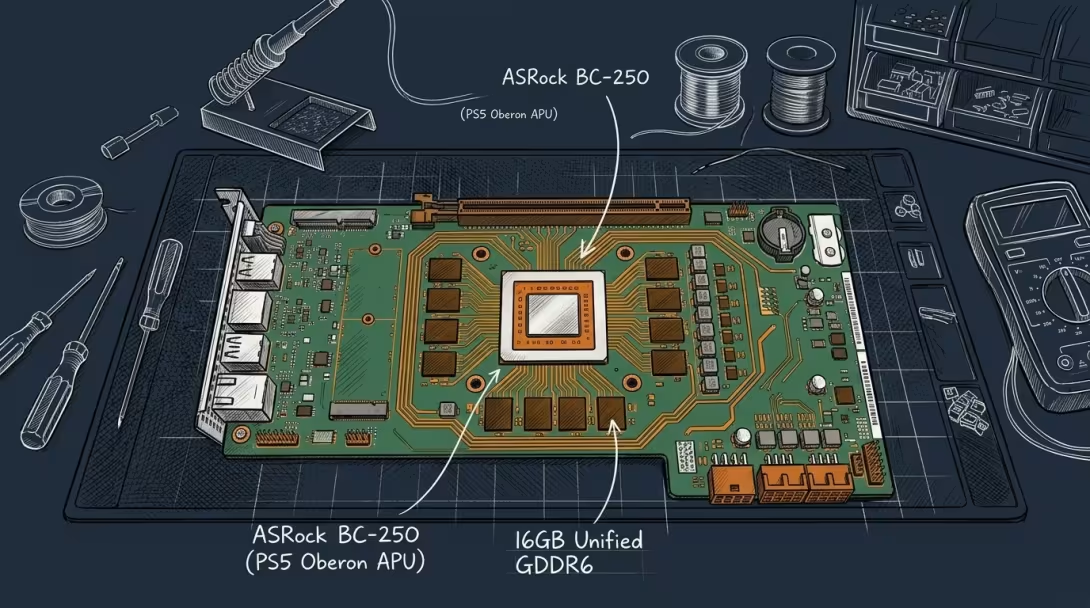
When industrial crypto-mining operations shut down across the globe, liquidators were left with warehouse shelves packed with thousands of green, bare circuit boards labelled ASRock AMD BC-250.
To liquidators and scrap merchants, these unadorned motherboards looked like electronic waste. They lacked standard rear I/O display ports, came with no retail packaging, and were designed strictly for headless mining server racks.
To PC building enthusiasts and retro gaming hackers, however, the BC-250 was an astonishing discovery: a PlayStation 5 APU repurposed into a desktop PC motherboard.
2. Under the Hood: Deconstructing the Frankenstein APU
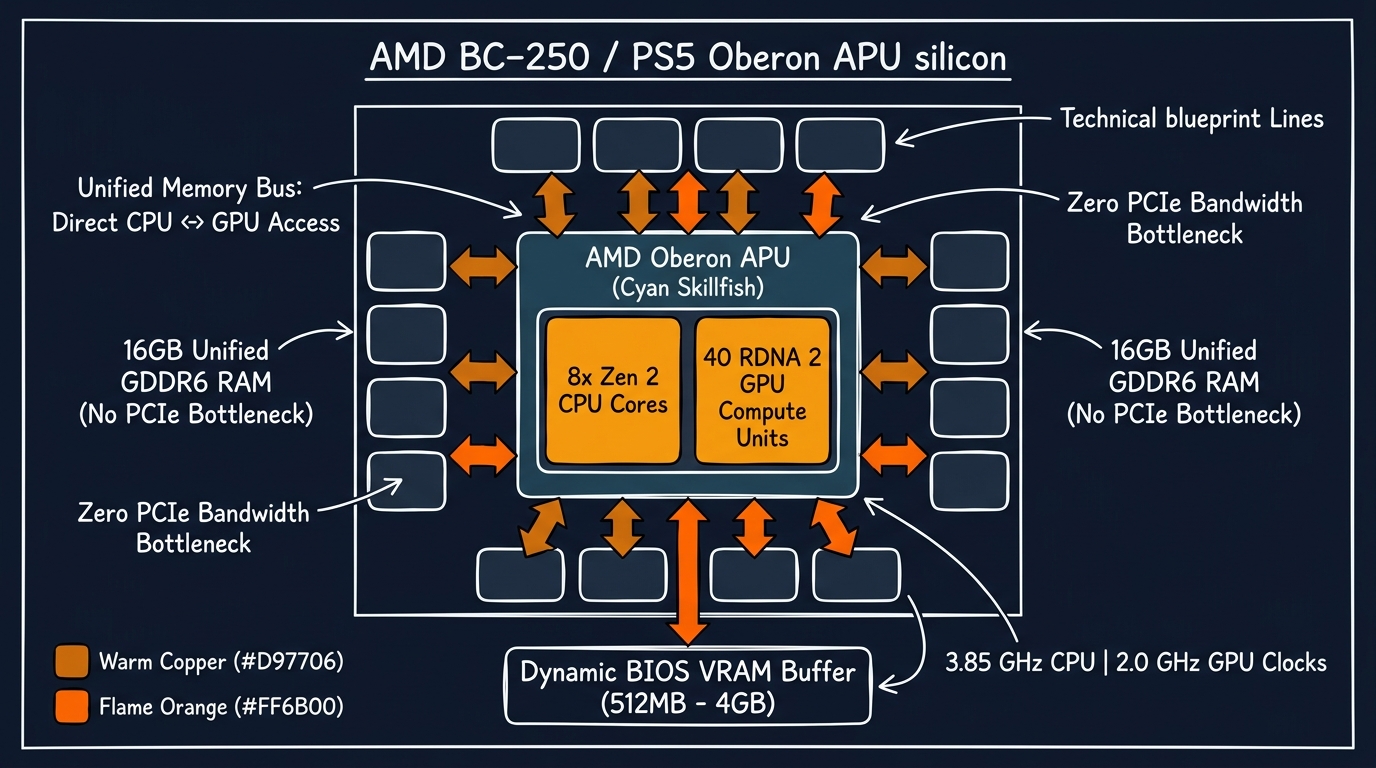
Built around AMD’s semi-custom "Cyan Skillfish" (Oberon) APU, the BC-250 contains the exact physical silicon powering Sony's PlayStation 5 console.
+-----------------------------------------------------------------------+
|                       AMD BC-250 APU ARCHITECTURE                     |
|                                                                       |
|  [ 8 Zen 2 CPU Cores / 16 Threads ] <---> [ 16GB Unified GDDR6 RAM ]  |
|                                                  ^                    |
|  [ 40 RDNA 2 GPU Compute Units    ] <------------+                    |
+-----------------------------------------------------------------------+
1. 8 Zen 2 CPU Cores & 40 RDNA 2 Compute Units
Underneath the heavy aluminum heatsink lies a monolithic x86-64 die featuring:- 8 Zen 2 CPU Cores / 16 Threads operating at up to 3.85 GHz when unlocked.
- 40 RDNA 2 GPU Compute Units (CUs)—providing graphics horsepower comparable to a desktop Radeon RX 6600.
2. The Game-Changer: Unified GDDR6 Memory Architecture
Standard desktop PCs rely on DDR4 or DDR5 system RAM. When an integrated GPU (APU) shares memory with the CPU, standard DDR RAM creates severe bandwidth bottlenecks that bottleneck graphics performance.Just like a PS5, Xbox Series X, or Steam Deck, the BC-250 features a unified GDDR6 memory architecture. 16GB of ultra-fast GDDR6 memory is soldered directly onto the motherboard and shared dynamically between the CPU and RDNA 2 GPU.
Because GDDR6 provides massive memory bandwidth (over 400 GB/s), emulators and 3D games get access to high-speed VRAM allocation that standard mini PCs and budget desktop APUs simply cannot match.
3. Stock Mining Specs vs. Unlocked Community Firmware
Out of the box, factory mining firmware crippled the BC-250 to save power in server racks. However, the hardware community developed unlocked BIOS profiles (such as Robin 5.00):
| Hardware Parameter | Factory Mining Firmware | Community Unlocked (Robin 5.00 BIOS) |
PS5 Reference |
|---|---|---|---|
| CPU Cores / Threads | 6 Cores / 12 Threads | 8 Cores / 16 Threads | 8 Cores / 16 Threads |
| GPU Architecture | RDNA 2 ("Cyan Skillfish") | RDNA 2 ("Cyan Skillfish") | Custom RDNA 2 |
| Compute Units (CUs) | 24 CUs | Up to 40 CUs | 36 CUs |
| Memory | 16GB GDDR6 (Unified) | 16GB GDDR6 (Unified) | 16GB GDDR6 (Unified) |
| VRAM Allocation | Fixed Mining Cap | Dynamic / Configurable (up to 12GB) | Unified |
4. The Linux Mandate: Why Windows is Left Out
There is one critical quirk with Cyan Skillfish silicon: Windows is completely unsupported.
Because AMD never released official Windows display drivers for the BC-250 APU, running Windows results in Microsoft Basic Display Adapter mode—zero 3D hardware acceleration, zero Vulkan support, and unusable performance.
Linux, however, changes everything. Thanks to the open-source Mesa drivers (RADV Vulkan driver & kernel graphics stack), Linux natively supports the RDNA 2 graphics cores. Combined with immutable gaming distributions like Bazzite OS, the BC-250 transforms into a full-fledged living room Steam Machine.
5. What Makes This Hardware Legend Worth Modding?
The BC-250 sits at a unique intersection in PC gaming history:
1. Unbeatable Price-to-Performance: Rescued from crypto liquidators for ~EUR 200–220.
2. Console-Class Architecture: Real PS5 silicon running open-source Linux software.
3. Pure Tinkerer Satisfaction: Requires custom cooling, power wiring, and 3D-printed enclosures.
In the next article, I will detail my component sourcing strategy and project blueprint for turning this raw mining board into a custom 240mm liquid-cooled living room console.