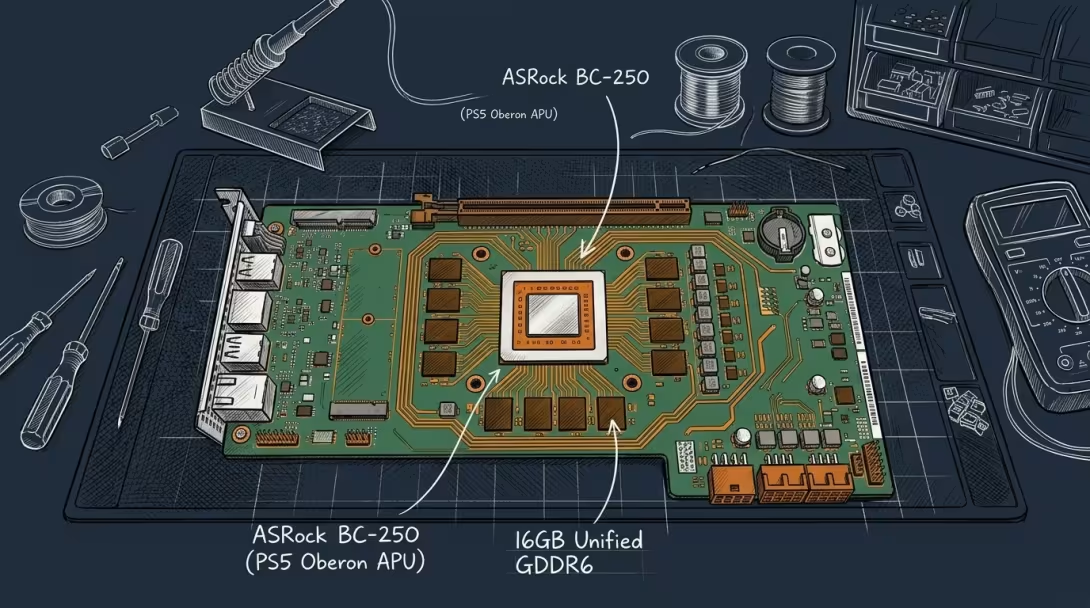
AMD BC-250: Repurposing PlayStation 5 Silicon for Linux Desktops
1. Background & Origin
Following the shift in cryptocurrency mining economics, decommissioned mining hardware surfaced in volume on surplus markets. Among these boards is the ASRock AMD BC-250, an OEM system board originally manufactured for high-density mining chassis.
Unlike standard commodity PC hardware, the BC-250 is built around AMD’s semi-custom Cyan Skillfish (Oberon / Ariel) silicon—the identical APU platform manufactured for the Sony PlayStation 5. While stripped of standard consumer features and sold as a bare PCB, the platform offers an x86 host paired with unified high-bandwidth memory.
2. Silicon Architecture & Memory Subsystem
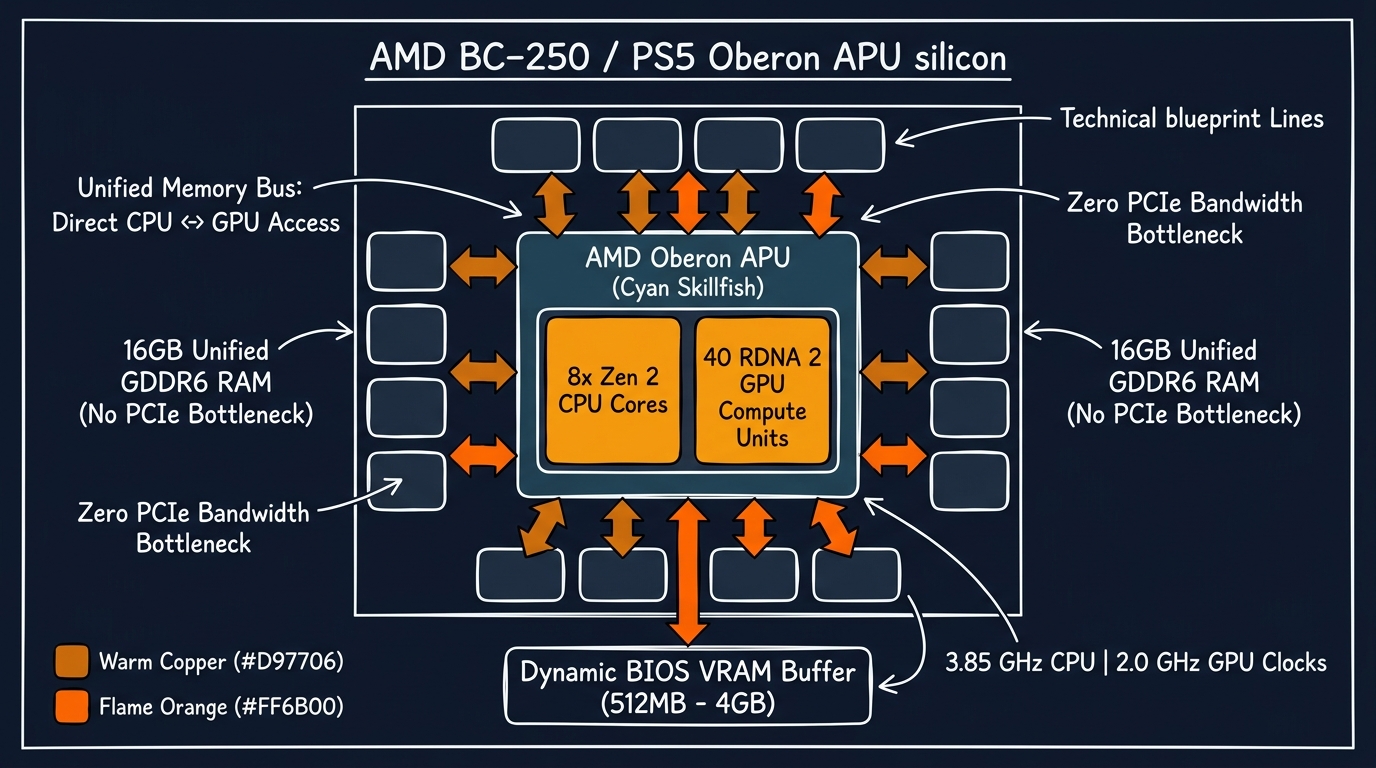
The BC-250 features a monolithic TSMC 7nm die containing Zen 2 x86 cores alongside an RDNA 2 graphics pipeline.
+-------------------------------------------------------------------------+
|                        AMD BC-250 (CYAN SKILLFISH)                      |
|                                                                         |
|   +--------------------------+                                          |
|   |  8 Zen 2 CPU Cores       | <----+                                   |
|   |  16 Execution Threads    |      |                                   |
|   +--------------------------+      v                                   |
|                                [ Coherent Bus ] <---> [ 16GB GDDR6 ]    |
|   +--------------------------+      ^                 [ >400 GB/s  ]    |
|   |  Up to 40 RDNA 2 CUs     |      |                                   |
|   |  Compute Pipeline        | <----+                                   |
|   +--------------------------+                                          |
+-------------------------------------------------------------------------+
Core Architecture
- CPU: 8 Zen 2 cores / 16 threads running at a fixed 3.50–3.85 GHz ceiling (depending on firmware configuration).
- GPU: AMD RDNA 2 engine with 40 physical Compute Units (CUs). In graphics compute capability, the die is roughly comparable to a discrete Radeon RX 6600.
The Unified GDDR6 Subsystem
Standard desktop APUs are bounded by standard DDR4/DDR5 bandwidth limits across dual-channel 64-bit buses, creating a persistent memory throughput bottleneck for the integrated GPU.The BC-250 bypasses this via a unified 256-bit memory bus with 16GB of onboard GDDR6, delivering upwards of 400 GB/s bandwidth shared directly between the CPU and GPU. This mirrors the console memory model, providing low-latency, high-bandwidth VRAM access.
3. Stock Limitations vs. Community Modifications
The factory mining configuration ships severely restricted to maintain low thermals, reduce power consumption, and tolerate marginal silicon binning. Unlocking the platform requires a combination of modified system firmware and kernel patches.
| Hardware Parameter | Factory Mining Spec | Unlocked Community Spec | Reference PS5 Console |
|---|---|---|---|
| CPU Topology | 6 Cores / 12 Threads | 8 Cores / 16 Threads (SMU unlock) | 8 Cores / 16 Threads |
| GPU Architecture | RDNA 2 (Cyan Skillfish) | RDNA 2 (Cyan Skillfish) | Custom RDNA 2 |
| Active CUs | 24 CUs | Up to 40 CUs (via kernel patch) | 36 CUs |
| Memory | 16GB GDDR6 (Unified) | 16GB GDDR6 (Unified) | 16GB GDDR6 (Unified) |
| VRAM Policy | Static carve-out | 512MB Dynamic UMA (Recommended) | Unified Dynamic |
| Video Out | 1x DisplayPort 1.4 | 1x DisplayPort (Active conversion needed for HDMI) | HDMI 2.1 |
amdgpu kernel patch.
Note on Memory Allocation: Setting a static 12GB VRAM partition in BIOS starves the host OS, leaving only 4GB for userspace and provoking Out-Of-Memory (OOM) faults. A 512MB initial UMA setting allows the kernel to allocate system memory dynamically as graphics load demands.
4. Platform Software Constraints
Windows Lack of Driver Support
AMD never released an official Windows graphics driver package for Cyan Skillfish. Booting Windows results in standard VESA/Microsoft Basic Display Adapter fallback—meaning no D3D acceleration, no Vulkan runtime, and no viable compute support.The Linux Graphics Stack
Hardware acceleration requires modern Linux. Upstream support is handled via the native kernel driver (amdgpu) and Mesa (RADV Vulkan driver). Using an immutable or gaming-oriented distribution (such as Bazzite or Arch) provides a functional platform for Steam/Proton workloads, emulation, and general Linux desktop environments.
5. Build Considerations
The BC-250 presents several non-standard physical and electrical constraints:
- Power Delivery: Powered exclusively via 12V EPS / PCIe power lines; it lacks an ATX 24-pin interface and requires custom breakout cabling or a dedicated mining/industrial PSU.
- Cooling: The stock passive aluminum block is designed for high-CFM server rack airflow. Desktop deployment necessitates a custom cooling bracket, AIO liquid cooler, or adapted copper baseplate.
- Chassis & I/O: The board does not conform to standard mATX/ITX standoff patterns, requiring a custom bench, modified chassis, or 3D-printed mounting brackets.
Part two of this series covers Sourcing & Preparing My AMD BC-250 Living Room Console.