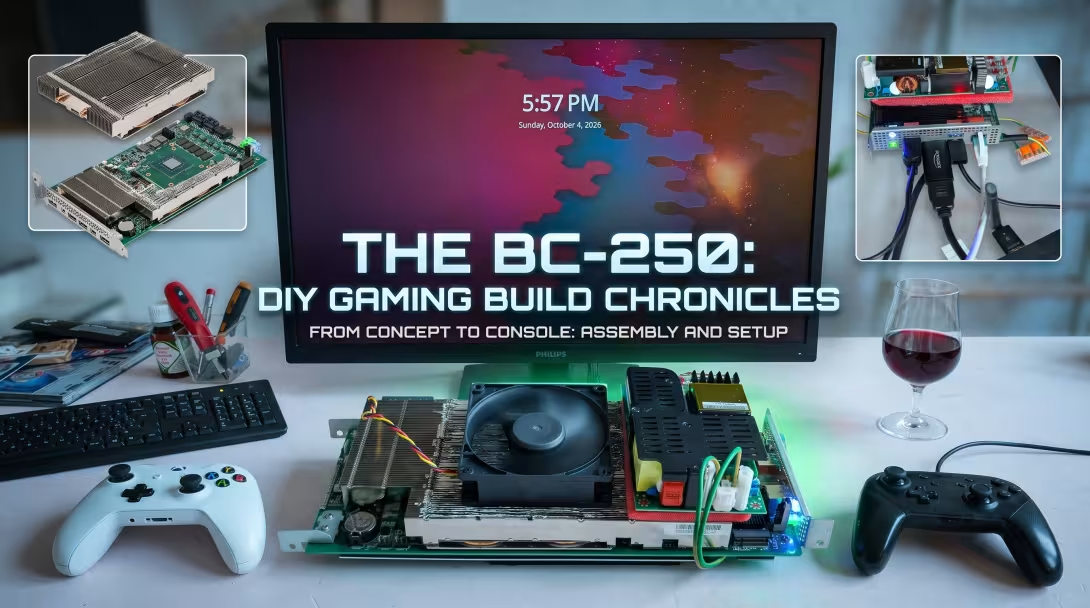
🎮 Repurposing PS5 Silicon: Building an Open Linux Console from Crypto Mining E-Waste
The genesis of the build: choosing the hard path over an off-the-shelf retail console.
"Why buy a neat, plug-and-play retail box when you can wire an industrial Mean Well open-frame power supply with WAGO connectors to decommissioned PS5 crypto-mining silicon, wrestle custom cooling, and pray your connectors don't melt?"
TL;DR
- The E-Waste Genesis: Following Ethereum's transition to Proof-of-Stake, surplus industrial mining racks flooded secondary markets with ASRock AMD BC-250 boards—bare OEM cards carrying genuine Sony PlayStation 5 Cyan Skillfish (Oberon) APUs for ~€220.
- Console Architecture Advantage: Unlike traditional desktop APUs throttled by dual-channel DDR4/DDR5 buses (50–90 GB/s), the BC-250 features 16GB of unified GDDR6 across a 256-bit bus delivering >400 GB/s bandwidth.
- Electronics Engineering: Lacking standard ATX or EPS power headers, power is engineered through an open-frame Mean Well LOP-500-12 single-rail PSU, terminated via JST VH3.96, and distributed through WAGO 221-415 lever nuts into 18 AWG PCIe 8-pin inputs.
- Overcoming Hardware Quirks: Bypasses the lack of Windows display drivers via upstream Linux (
amdgpu+ Mesa RADV) and secures custom BIOS memory configurations with a CR2032 coin cell. - Silent Air Cooling: Skips bulky, leak-prone 240mm AIO liquid loops for direct air cooling: Corsair XTM50 paste on the bare die, Arctic TP-3 thermal pads across GDDR6/VRMs, and an Arctic PWM fan holding 62–68°C under load.
- Custom Enclosure in Progress: Wrapping the build into a dedicated living room console with a custom BC-250 chassis currently being 3D-printed in blue, cleanly housing the internal Mean Well PSU alongside dual 140mm intake fans.
- Living Room Appliance: Running Bazzite Linux (Steam Gaming Mode) with a dialed-in 4GB VRAM / 11.4GB RAM balance delivers locked 60 FPS emulation from PS2 to Nintendo Switch for a fraction of the cost of commercial mini PCs.
+--------------------------------------------------------------------------+
|                     SYSTEM TOPOLOGY & SPECS AT A GLANCE                  |
+--------------------------------------------------------------------------+
| Silicon:      AMD BC-250 APU (Oberon / Cyan Skillfish, 7nm TSMC)         |
| CPU Arch:     4 Cores / 8 Threads active Zen 2 @ 3.20 GHz                |
| GPU Arch:     RDNA 2 Compute Architecture (amdgpu DRM 3.64 / Mesa 26.2)  |
| Memory Pool:  16 GB Unified 256-bit GDDR6 (>400 GB/s bandwidth)          |
|   - VRAM:     4.00 GB Dedicated Carveout (amdgpu DRM)                    |
|   - Host RAM: 11.40 GB Usable Userspace RAM + 5.7 GB zram swap           |
| Power Supply: Mean Well LOP-500-12 (500W 12V Single Rail) + WAGO 221-415 |
| Thermals:     Corsair XTM50 Paste + Arctic TP-3 Pads + Arctic PWM Fan    |
| Enclosure:    3D-Printed Blue Chassis (Internal PSU + 2x 140mm Fans)     |
| Display:      DisplayPort 1.4 -> Delock Active DP-to-HDMI 2.1 Adapter    |
| OS Platform:  Bazzite 44 (Kinoite / Linux 7.2.7-ogc gaming kernel)       |
+--------------------------------------------------------------------------+
1. The Genesis: Rescuing PS5 Silicon from Crypto E-Waste
When the cryptocurrency market underwent its major architectural shift—most notably Ethereum migrating from energy-intensive Proof-of-Work (PoW) to Proof-of-Stake (PoS)—vast industrial mining farms suddenly found specialized hardware obsolete overnight. Decommissioned server chassis were stripped down, and bare OEM boards surfaced on international liquidation surplus markets like AliExpress and eBay.
Among these boards lies an extraordinary anomaly: the ASRock AMD BC-250.
Sold for roughly €220, the BC-250 is not an ordinary PC motherboard. At its core sits AMD’s semi-custom Cyan Skillfish (Oberon / Ariel) system-on-chip—the exact monolithic 7nm silicon manufactured for the Sony PlayStation 5.
+-------------------------------------------------------------------------+
|                        AMD BC-250 (CYAN SKILLFISH)                      |
|                                                                         |
|   +--------------------------+                                          |
|   |  Zen 2 CPU Cores         | <----+                                   |
|   |  (4C / 8T Active @ 3.2G) |      |                                   |
|   +--------------------------+      v                                   |
|                                [ Coherent Bus ] <---> [ 16GB GDDR6 ]    |
|   +--------------------------+      ^                 [ >400 GB/s  ]    |
|   |  RDNA 2 Graphics Engine  |      |                                   |
|   |  (Cyan Skillfish CUs)    | <----+                                   |
|   +--------------------------+                                          |
+-------------------------------------------------------------------------+
The Windows Void vs. The Linux Salvation
There was a catch that scared off mainstream PC builders: AMD never released an official Windows graphics driver for Cyan Skillfish. Booting Windows on the BC-250 drops to Microsoft Basic Display Adapter mode—meaning zero 3D hardware acceleration, no DirectX, no Vulkan, and no usable desktop gaming.Under modern Linux, however, the picture completely flips:
- The native upstream Linux kernel driver (
amdgpu) recognizes the Cyan Skillfish GPU architecture. - The open-source Mesa RADV Vulkan driver provides high-performance, low-overhead 3D acceleration.
- Combined with an immutable gaming distribution like Bazzite (Steam Gaming Mode), this industrial e-waste can be transformed into an open, couch-friendly console for a fraction of commercial mini PC costs.
2. Hardware Architecture & Memory Subsystem
Desktop APUs (like the AMD Ryzen 5700G or 8700G) share a fundamental bottleneck: the integrated graphics core must fetch textures and assets across narrow 64-bit dual-channel DDR4 or DDR5 desktop RAM. This caps memory bandwidth around 50–90 GB/s, starving the GPU during high-resolution rendering.
The BC-250 solves this by implementing Sony's unified console memory architecture:
- 256-bit Unified GDDR6 Subsystem: 16GB of high-speed GDDR6 memory is soldered directly onto the PCB around the APU, delivering upwards of 400 GB/s bandwidth shared coherently between the Zen 2 CPU cores and RDNA 2 compute units.
- Firmware Silicon Binning: While the physical die contains up to 40 RDNA 2 CUs and 8 Zen 2 cores, mining firmware bins and activates 4 cores / 8 threads at a locked 3.20 GHz with 24 to 32 CUs active, maximizing stability and package efficiency.
Dialling in the Memory Balance: The 4GB Sweet Spot
Because all 16GB of GDDR6 is unified, the firmware VRAM allocation policy is critical:
- The 12GB Pitfall: Assigning a massive 12GB static VRAM slice in firmware starves Linux, leaving less than 4GB for the kernel, Proton runtimes, and background processes—triggering instant Out-Of-Memory (OOM) killer terminations.
- The 4GB Sweet Spot: Allocating 4.00 GB for dedicated VRAM leaves a spacious 11.40 GiB for system userspace, backed by 5.7 GB of zram swap and a 16 GB NVMe swapfile.
- Zero-Penalty GTT Paging: When emulators or modern PC titles demand more than 4GB VRAM,
amdgpuleverages the Graphics Translation Table (GTT) to allocate additional host memory dynamically. Because system RAM and VRAM share the identical physical 256-bit GDDR6 memory bus, GTT spillover incurs zero bus bandwidth penalty.
3. Electronics Engineering: 12V Single-Rail Power Delivery
Because the BC-250 was manufactured exclusively for high-density crypto mining racks, it completely lacks standard 24-pin ATX, 8-pin EPS, or 12VHPWR motherboard connectors. It feeds strictly on raw 12V DC power.
flowchart TD
    AC["220V AC Mains"] --> JST["3-pin JST VH3.96 Connector"]
    JST --> PSU["Mean Well LOP-500-12
(500W 12V Single-Rail Open Frame)"]

    PSU -->|"+12V DC"| WAGO_POS["WAGO 221-415 (+12V Distribution)"]
    PSU -->|"GND"| WAGO_GND["WAGO 221-415 (GND Distribution)"]

    WAGO_POS --> PCIe["18 AWG 8-pin PCIe Connector"]
    WAGO_GND --> PCIe
    PCIe --> MOB["BC-250 Motherboard Power Sockets"]

    style AC fill:#f4f4f4,stroke:#666,stroke-width:1px
    style PSU fill:#e1f5fe,stroke:#0288d1,stroke-width:1.5px
    style WAGO_POS fill:#ffebee,stroke:#d32f2f,stroke-width:1px
    style WAGO_GND fill:#eceff1,stroke:#455a64,stroke-width:1px
    style PCIe fill:#e8f5e9,stroke:#388e3c,stroke-width:1.5px
The Power Harness Build Steps:
1. The Power Supply Unit: Rather than using overpriced server breakouts, an industrial Mean Well LOP-500-12 (500W 12V single-rail open frame, ~€77) delivers clean, fanless DC power in an ultra-compact footprint. 2. AC Mains Input: Terminated the 220V mains cable using a 3-pin JST VH3.96 (3.96mm pitch) female housing, securely locking phase, neutral, and earth into the high-voltage input header. 3. DC Distribution via WAGO 221: High transient current (>15–20A) can easily overheat poorly crimped terminals. Bridging the Mean Well's output screw terminals into two compact WAGO 221-415 5-conductor lever connectors cleanly consolidates positive +12V lines and grounds. 4. PCIe Power Extension: Stripped 18 AWG deleyCON PCIe 6+2 pin leads plug firmly into the WAGO distribution blocks and power the BC-250's onboard PCIe power headers. 5. BIOS Persistence (CR2032): The bare board ships without a CMOS battery. Installing a standard CR2032 coin-cell battery into the onboard holder is mandatory to preserve custom UMA memory allocation and boot order across reboots.4. Thermal Engineering: Silent Air Cooling
Early community builds reached for 240mm or 360mm AIO liquid coolers, requiring custom CNC retention brackets, pump wiring, and leak risks in a living room. An optimized air-cooling setup proves far simpler, lighter, and remarkably quiet:
1. Bare Die Repasting: The industrial factory thermal paste was dried and uneven. The APU die was stripped with 99.9% isopropyl alcohol and treated with fresh Corsair XTM50 high-performance thermal paste.
2. VRM & VRAM Thermal Array: Arctic TP-3 thermal pads were placed across the MOSFETs, inductors, and rear GDDR6 memory packages to conduct transient heat into the heatsink assembly.
3. Arctic PWM PST Cooling: An Arctic PWM PST fan is mounted directly over the dense central aluminum fin stack above the APU die, utilizing Arctic's integrated PST daisy-chain header to seamlessly support additional VRM airflow.
4. Single-Header Automation: Connected directly into the BC-250's single motherboard 4-pin PWM header, the system dynamically regulates fan speeds based on silicon temperature—running near-silent at idle and holding stable temperatures around 62–68°C under full synthetic gaming load.
The Custom 3D-Printed Enclosure (In Progress)
While open-bench testing on the maker desk verified thermal and electrical stability, a permanent living room console requires a proper, rigid enclosure to protect the open-frame power supply and organize cables.Rather than cramming the hardware into a standard PC case with awkward adapters, a dedicated custom chassis is currently being 3D-printed in blue:
- Community Design: Based on the BC-250 Case with Internal PSU & 2x 140mm Fans model on Printables.
- Internal PSU Integration: The chassis cleanly integrates the open-frame Mean Well LOP-500-12 power supply inside the enclosure alongside the motherboard, fully concealing the 12V wiring harness and WAGO distribution blocks within a unified console footprint.
- Dual 140mm Fan Array: Twin 140mm fans mount directly to the enclosure, establishing an ultra-quiet, high-volume cross-flow tunnel directly over the APU heatsink and power delivery circuitry, ensuring continuous positive internal air pressure.
5. Software Deployment & Living Room Emulation
To turn this hardware into a true appliance-like console, Bazzite 44 (Kinoite edition) was deployed onto a 2TB Samsung NVMe SSD.
Installation Nuance
While booting Bazzite from a USB thumbdrive (using theDelete key during POST to override the boot disk), Bazzite's immutable rpm-ostree deployment requires active network connectivity during installation to pull and verify deployment commits. Connecting a wired Ethernet cable allowed the installer to pass this step seamlessly.
+----------------------------------------------------------------------------------+
|                     DETAILED GRAPHICS DRIVER INFORMATION                         |
+----------------------------------------------------------------------------------+
| Kernel Driver:   amdgpu                                                          |
| Hardware Device: AMD Cyan Skillfish / BC-250 (01:00.0, gfx1013, 1002:13fe)       |
| Kernel DRM:      DRM 3.64 (Kernel: 7.2.7-ogc1.1.fc44.x86_64)                     |
| Userspace Mesa:  radeonsi (Mesa 26.2.2, ACO compiler)                            |
| OpenGL Profile:  OpenGL 4.6 (Core Profile) / ES 3.2                              |
+----------------------------------------------------------------------------------+
Living Room Controllers & RF Management
- 8BitDo Ultimate Wireless (2.4 GHz): Connecting the 2.4 GHz USB adapter to an external USB hub provides instant, low-latency couch gaming with zero Bluetooth pairing rituals.
- PlayStation 5 DualSense Support: Under Bazzite, Sony's official
hid-playstationkernel module is baked directly into the system, enabling native DualSense support via an external Bluetooth 5.3 dongle (touchpad cursor control, motion gyro aiming, and couch auto-reconnect). - RF Interference Pro-Tip: Placing the Bluetooth dongle away from high-speed USB 3.0 ports prevents 2.4 GHz packet drop and latency spikes.
Emulation Tier Performance (EmuDeck & EmulationStation-DE)
| Console Generation | Target Emulator | Resolution / Scaling | Observed Performance |
|---|---|---|---|
| 8-bit / 16-bit / PS1 / N64 | RetroArch (Beetle, Mupen64) | 4K Native + CRT-Royale Shaders | Locked 60 FPS (Flawless) |
| PlayStation 2 | PCSX2 (Vulkan backend) | 3x Native (1080p) / 4x (1440p) | Locked 60 FPS (Gran Turismo 4, God of War II) |
| Nintendo GameCube / Wii | Dolphin (Vulkan backend) | 3x–4x Internal Resolution | Locked 60 FPS (F-Zero GX, Metroid Prime) |
| PlayStation 3 | RPCS3 (Vulkan + LLVM Recompiler) | 720p Native / 1080p Scaled | 30–60 FPS (Demon's Souls, Persona 5) |
| Nintendo Switch | Eden / Ryujinx (Vulkan) | 1080p Docked | Locked 60 FPS (Mario Kart 8 Deluxe, Super Mario Odyssey) |
6. Conclusions: Circular Electronics in Practice
Rescuing the AMD BC-250 from the crypto mining scrapheap and transforming it into an ultra-quiet, 8-thread living room console demonstrates the untapped potential of e-waste repurposing.
By understanding the underlying silicon architecture, engineering a robust 12V DC power harness, and leveraging the open-source Linux graphics stack, we built an open, repairable, high-bandwidth gaming console powered by genuine PlayStation 5 silicon—for less than half the cost of a commercial mini-PC.