
🤖 Engineering Log: Adopting Ponytail Minimalism & Sweeping Over-Engineered Automation
A technical recap of system improvements made to the Personal Assistant codebase between August 11 and August 14, 2026.
📸 System Architecture & Visual Overview
🏗️ Technical Architecture & Refactoring Flow

Diagram: End-to-end architecture flow — from workspace rule governance to dynamic path resolution, script consolidation, and Drupal publishing.
🚀 Overview: The Shift Toward Minimalist Engineering
Since our last milestone report on August 11, 2026—which established the assistant's Lt. Commander Data identity, self-hosted GitHub Mobile runner loops, and automated source directory archiving—the Personal Assistant (PA) ecosystem has evolved rapidly.
However, rapid feature development often leaves behind over-engineered abstractions, hardcoded path conditionals, and duplicate template generators. To address this, we integrated Ponytail principles directly into the core PA instruction set. Ponytail enforces a "lazy senior developer" discipline: writing the least code that cleanly solves the problem without ever sacrificing security, input validation, or accessibility.
🪜 1. Standardizing "The Ladder" in Core Workspace Rules
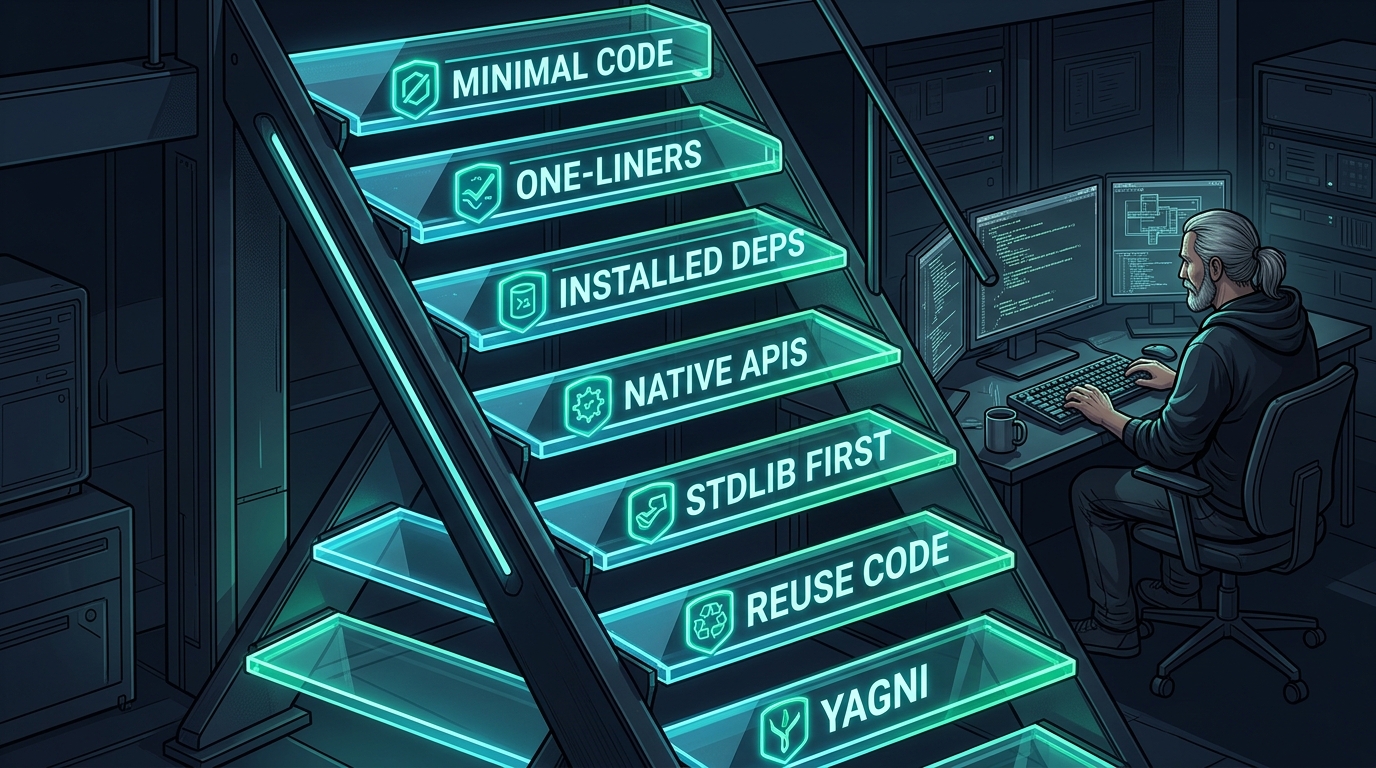
Image: The 7-rung Ladder of Minimalist Engineering Rules (AI-impression)
We updated the primary workspace rules file at .agents/AGENTS.md with a permanent Minimalist Code & Engineering Principles directive.
Before any code is generated or modified, the PA now evaluates every decision against The Ladder:
1. YAGNI (You Aren't Gonna Need It): Skip speculative features or unused abstraction layers.
2. Reuse Existing Codebase: Check existing utilities and design patterns before creating new ones.
3. Standard Library First: Prefer built-in Python/Node modules over external dependencies or custom wrappers.
4. Native Platform Features: Use native browser/OS capabilities (e.g., standard Web APIs, HTML5 inputs) over third-party UI libraries.
5. Installed Dependencies: Use already-installed packages before adding new ones.
6. Expressive One-Liners: Prefer clear, readable built-ins (e.g., @lru_cache, Array.prototype.find) over verbose multi-line classes.
7. Minimum Code: Write only what is strictly necessary to deliver production-grade code.
🧹 2. Repository Bloat Audit & Ghost Artifact Cleanup
Conducting a comprehensive Ponytail Audit across the repository revealed several edge-case maintenance issues:
- Escaped Path Directory Cleanup: Cross-platform path string evaluation between WSL (
/mnt/c/) and Windows host paths (c:/) had left behind an accidental escaped directory artifact (c:). This ghost folder was completely scrubbed. - Git Bytecode Hygiene: Added
__pycache__/and*.pycrules to.gitignoreand removed cached bytecode tracking from the repository index.
⚙️ 3. Automation Consolidation & Script Refactoring
Consolidating Post Generators (handle_mobile_issue.py)
Previously, handle_mobile_issue.py maintained four separate generator functions (generate_destination_guide, generate_hardware_post, generate_linux_post, generate_general_post), repeating ~180 lines of frontmatter and formatting boilerplate.
We consolidated these routines into a single map-driven generate_post(intent, topic_name) function. This single refactor removed 82 lines of redundant code from a 511-line script while preserving exact frontmatter and content rendering behavior.
Cross-Platform Path Resolution
Scripts throughoutscripts/ previously relied on fragile fallback checks:
# ❌ Legacy path guessing repeated across scripts
base_repo_path = "/mnt/c/GIT/personal-assistant"
if not os.path.exists(base_repo_path):
    base_repo_path = "c:/GIT/personal-assistant"
We updated handle_mobile_issue.py, poll_mobile_issues.py, and compile_mister_docs_guide.py to resolve repo roots dynamically relative to script location:
# ✅ Ponytail standard library one-liner
base_repo_path = Path(__file__).resolve().parents[1]
This guarantees seamless execution across native Windows PowerShell, WSL Ubuntu, and GitHub Actions runners.
📚 4. Exhaustive Wiki Scraping Pipeline
On August 13, 2026, we launched an automated documentation compiler for the official MiSTer FPGA MkDocs Wiki.
Following Ponytail Rung 3 (Stdlib First), scrape_mister_docs.py was built using Python's native urllib.request and html.parser modules instead of pulling in heavy external scraping frameworks. The pipeline scraped all 75 wiki pages and compiled them into the comprehensive master guide post at mister-fpga-documentation-summary.
📊 Summary of Codebase Metrics
| Metric | Before Audit | After Audit | Change |
|---|---|---|---|
handle_mobile_issue.py Lines |
511 lines | 429 lines | −82 lines (−16%) |
| Workspace Git Diff | 117 additions | 195 deletions | −78 net lines |
| Path Hardcoding | 4 scripts | 0 scripts | 100% Dynamic |
| Python Syntax Errors | 0 | 0 | Verified Clean |
🎯 What's Next
With Ponytail rules embedded in core guidance and the automation runner streamlined, our PA workspace is leaner, faster, and easier to maintain. Future feature additions will strictly adhere to "The Ladder", keeping codebase complexity to an absolute minimum.