✦ Personalize your reading feed:

🧳 Travel & Field Guides

Alpine hiking routes, landmark checklists, dog-friendly venue badges, and live 5-day weather forecasts.

View Section →

🎮 Retro Gaming & Hardware Mods

Cycle-accurate FPGA gaming, 3D-printed Steam Deck modifications, and hardware teardowns.

View Section →

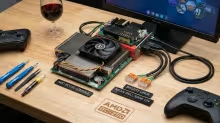
Repurposing PS5 Silicon: Building an Open Linux Console from Crypto Mining E-Waste

The complete engineering journey of converting decommissioned ASRock AMD BC-250 mining motherboards—powered by genuine PlayStation 5 Cyan Skillfish APUs—into high-performance, air-cooled living room Linux consoles with custom 12V power delivery and Bazzite OS.

🐧 Linux & System Engineering

Container-native operating systems, uBlue-OS custom builds, OCI layering, and bootc rebase.

View Section →

🤖 Assistant Labs & Workflows

Lt. Commander Data engineering logs, GitHub Actions CI/CD automation, and mobile runner logs.

View Section →

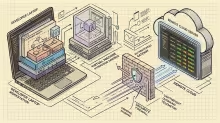
The Multi-Environment Parity Conundrum: Why Contrib Modules Fail Modern DevOps (And What Architects Do Instead)

A systems architect breakdown of the multi-workspace observability dilemma: why off-the-shelf CMS modules fail behind NAT firewalls, how uncommitted runtime updates cause catastrophic CI/CD rollback traps, and how to engineer an event-driven telemetry matrix across WSL2, Hyper-V, and cloud production.

🤖 AI & Enterprise Architecture

Fitting AI innovations into the Enterprise

View Section →

The Pragmatic AI Architect: Operationalizing Agentic Workflows Within Enterprise Banking

How enterprise solution architects in regulated banking environments can bridge the gap between high-velocity autonomous AI tools (like Google Antigravity) and standard enterprise copilot stacks (GitHub Copilot + M365 Copilot) to drive architectural clarity, process governance, and mutual understanding.

Inside Google Antigravity: How Autonomous AI Agents Are Redefining Engineering Velocity

A deep look into Google Antigravity—Google DeepMind's autonomous AI agent platform—and how multi-agent orchestration, unified state memory, and plan-first execution shift the developer role from inline autocomplete to high-velocity architectural delegation.